Magic circle containing a triangle
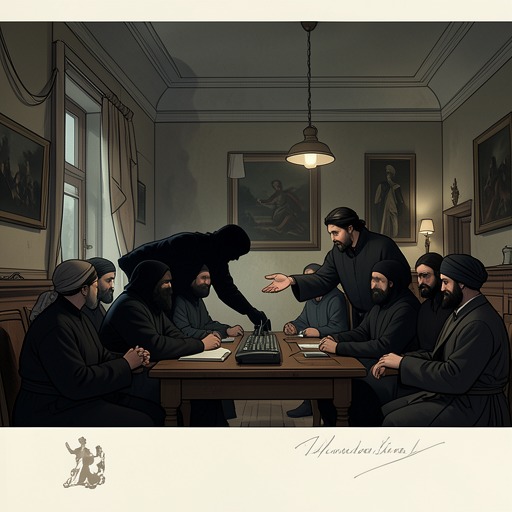
The Pale Blue EyeThe Magic circle containing a triangle is the geometric trace through which Augustus Landor and Edgar Allan Poe begin to interpret the taking of Leroy Fry’s heart as a religious or ceremonial act. First reconstructed from stones left in the grass near the Icehouse, the pattern gives their investigation a material clue and a symbolic vocabulary. Later, a room at the Icehouse displays a matching arrangement of fire: a circle of torches enclosing a triangle of candles. The design therefore links an inference made from traces to a visible ritual tableau, while leaving the rite’s meaning open to competing interpretations.
Discovery in the Grass
Landor’s reasoning begins with the possibility that the crime had a religious character. He connects Leroy Fry’s earlier association with a disreputable group and his subsequent turn to the Prayer Squad with the fact that Sylvanus Thayer regarded Fry’s body as suggesting religious fanaticism. Rather than assume that ceremonial objects would remain at the scene, Landor considers what their removal might leave behind. The perpetrators, he reasons, could take away stones or candles, but might not have time to fill the impressions they made in the ground, especially with a search party approaching and Fry’s heart requiring attention.
That idea determines the method of the search. Landor scans the pale grass for white stones, draws a pencil and notebook from his coat, and measures the distances between the stones while moving in a wave pattern. The notes become a lattice of dots. The arrangement is not an object found intact but a shape recovered through measurement: the investigators must turn scattered traces into a legible pattern. Their procedure makes the drawing both a record of evidence and an act of interpretation.
Edgar Allan Poe recognizes the outer figure as a circle. Landor estimates its diameter at ten feet, much larger than the space Leroy Fry’s body would occupy and large enough, in his comparison, to contain half a dozen bodies of Fry’s size. The scale makes it difficult to read the arrangement as a simple outline around the corpse. The inner points initially resist interpretation; Landor and Poe cannot connect them, and the dots seem to scatter the longer they examine the page. Landor then considers that some stones may have been missed, both around the circumference and inside it. When he draws lines through the closest points, the interior resolves into a triangle.
Reading the Pattern
The triangle’s position gives the geometry a connection to the crime scene beyond its abstract shape. Landor infers that Leroy Fry was inside it, and he begins to ask where the person performing the rite would have stood. The surviving evidence supports the inference that a ritual arrangement existed, but the pattern alone does not settle who occupied each position or what actions took place. The investigators have recovered a spatial plan, not a complete account of the ceremony.
Landor and Poe carry their drawing to Professor Pawpaw, laying it on a table made from a steamer trunk covered with pressed tin. Pawpaw offers several possible readings of the circle before addressing the inner figure. To an ancient Greek or alchemist, he says, the circle could represent the ouroboros and eternal unity; a medieval thinker might see creation and the void toward which creation tends. The triangle, however, leads him to identify the complete design as a magic circle. His response marks a transition from physical measurement to learned symbolic interpretation: one set of points can acquire different meanings according to the interpretive tradition brought to it.
Pawpaw recalls a similar design in Le Veritable Dragon Rouge and describes a magician standing in the triangle, perhaps with assistants there as well. In his account, candles would stand on either side and in front, with a brazier providing light. This is an explanation of how such a configuration might be used, not proof that every detail was present in the crime scene. Its value to the investigation is that it offers a possible arrangement of people and ritual objects that Landor and Poe can compare with the traces they have found.
From Reconstruction to Tableau
The earlier discovery and Pawpaw’s description acquire a concrete counterpart when Landor reaches a room inside the Icehouse. Through an opening in the wall, he sees rows of tapers burning in sconces, a circle of torches on the floor, and a triangle of candles inscribed within that circle. Nearby, a charcoal brazier sends flames nearly to the ceiling, and a pine tree has been braced in the stone and set alight. The arrangement is no longer a network of pale stones interpreted on paper: its geometric outline is made with fire, candles, and torches within a chamber.
The room also contains three figures moving among the lights: a small monk in a gray homespun robe, a priest in cassock and surplice, and an officer of the United States Army wearing what Landor takes to be Joshua Marquis’s old uniform. Landor arrives just as the Marquis family’s private ceremony is beginning. The visual match between the circle and triangle previously reconstructed near the Icehouse and the arrangement inside the chamber strongly connects the geometry to ritual practice. At the same time, the details of this later scene should not be retroactively treated as things the original ground pattern alone proved: the stones revealed an outline, while the room supplies an enacted arrangement and identifiable participants.
Contrast and Significance
The circle and triangle also stand in contrast with the public order of the United States Military Academy. During the evening parade on The Plain, cadets occupy companies, perform coordinated movements, and close the gap left by Leroy Fry so efficiently that a casual observer might not notice his absence. This is an organized spectacle of bodies moving within ranks. The Icehouse arrangement, by comparison, places figures and lights within a bounded geometric space. Both scenes make order visible through arrangement, but the parade’s order belongs to the Academy’s public discipline, while the recovered pattern points toward a concealed ceremony.
The design’s importance lies in this movement between trace, interpretation, and enactment. A few stones in grass first become a measured circle and triangle; Pawpaw’s account gives the shape a possible ritual use; the later room reveals a corresponding configuration made of flame. Yet symbolism does not erase uncertainty. The circle can carry different meanings in different intellectual traditions, and the evidence gathered at each stage differs in strength and kind. The pattern is decisive as a clue because it connects the murder investigation to deliberate ceremonial space, not because geometry by itself explains the ceremony or resolves every question about it.